Sheep Gestation Calculator
Ultimate Sheep Gestation Calculator: Predict Lambing Dates and Pregnancy Milestones
Managing a successful livestock operation requires precise scheduling, accurate record-keeping, and reliable health monitoring. Whether you are managing a commercial flock of hundreds of ewes or caring for a small homestead herd, calculating exact lambing dates is vital. Utilizing a sheep gestation calculator allows flock managers, homesteaders, and veterinarians to accurately forecast lambing windows, prepare maternity pens, adjust late-pregnancy nutritional rations, and organize veterinary interventions.
An online sheep gestation calculator takes the guesswork out of ovine breeding schedules. By factoring in mating dates, breed-specific gestation lengths, and key biological milestones, a digital sheep gestation calculator helps you prepare for the arrival of healthy lambs.
In this comprehensive guide, we will explore how to use our interactive sheep gestation calculator, examine the biological factors influencing ovine pregnancy, provide a 12-month breeding chart, and detail best management practices for every stage of ewe gestation.
[ez-toc]
How to Use Our Sheep Gestation Calculator
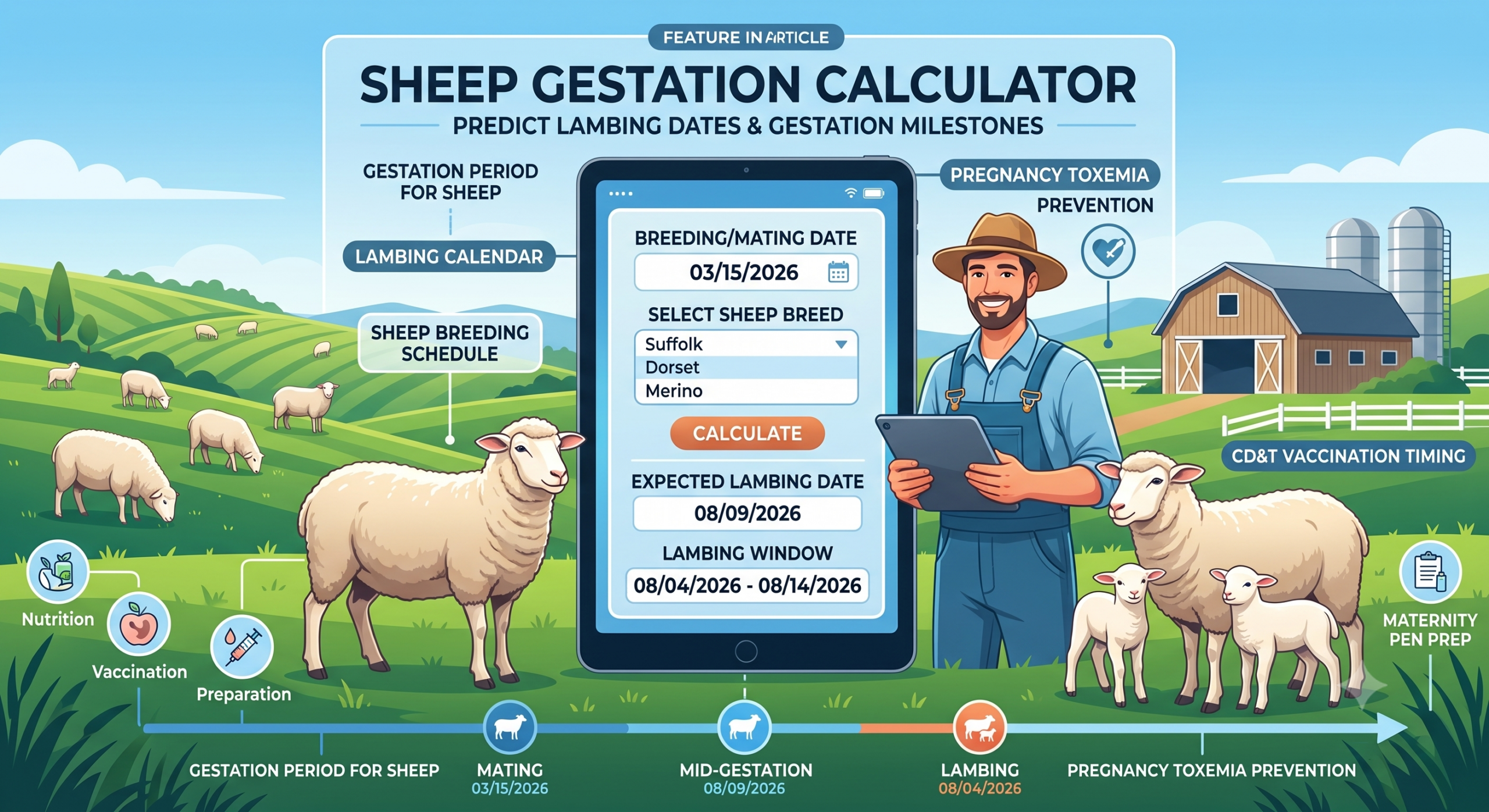
Our custom sheep gestation calculator is designed to provide quick, bidirectional date forecasting and automated milestone dashboard generation. Unlike static charts, this interactive sheep gestation calculator allows you to calculate forward from a mating date or plan backward from a target lambing date.
+-----------------------------------------------------------------------+
|                       SHEEP GESTATION CALCULATOR                      |
+-----------------------------------------------------------------------+
|  Sheep Breed: Standard / Mixed Breed                                  |
|                                                                       |
|  Date Exposed (Mated):  10 / 10 / 2026                                |
|  OR                                                                   |
|  Lambing (Birth) Date:  03 / 06 / 2027                                |
|                                                                       |
|  AUTO-FILL DATES & DASHBOARD                                          |
+-----------------------------------------------------------------------+
Step-by-Step Instructions
-
Select Your Sheep Breed:
Choose your ewe’s specific breed from the Sheep Breed dropdown menu. While the universal average gestation period for sheep is 147 days, individual breeds can vary between 142 and 152 days. Choosing the correct breed ensures your sheep gestation calculator output accounts for breed-specific gestation tendencies.
-
Input Breeding Date OR Target Lambing Date:
-
Forward Calculation: Enter the date your ewe was exposed to the ram in the Date Exposed (Mated) field.
-
Reverse Planning: If you need your lambs born on a specific date (for example, for market timing or show schedules), enter your desired date in the Lambing (Birth) Date field. Our sheep gestation calculator will calculate backward to reveal the exact date you should turn out your ram.
-
-
Click “Auto-Fill Dates & Dashboard”:
Press the button to process your inputs. The sheep gestation calculator generates the expected lambing date, the estimated 10-day lambing window, and key management milestones for nutrition shifts, vaccination dates, and lambing pen setups.
Why You Need a Gestation Calculator for Sheep
Relying on mental math or wall calendars to track flock reproduction often leads to timing errors. A dedicated gestation calculator for sheep provides several distinct management advantages:
-
Nutritional Precision: Over 70% of fetal growth occurs in the final six weeks of pregnancy. Using a gestation calculator for sheep ensures you increase energy and protein levels at the exact right time, preventing metabolic diseases like pregnancy toxemia (ketosis).
-
Vaccination Timing: Ewes require booster vaccinations (such as CD&T for enterotoxemia and tetanus) 2 to 4 weeks prior to lambing. A gestation calculator for sheep identifies this critical window so maternal antibodies transfer into colostrum effectively.
-
Facility Management: Knowing the exact week lambing begins allows you to clean, sanitize, and bed individual lambing pens (jugs) before labor starts.
-
Multi-Species Herd Planning: If you manage a diversified farm with multiple livestock species, combining our sheep gestation calculator with our swine gestation calculator and rabbit gestation calculator helps streamline birth management across your entire homestead.
Understanding the Gestation Period for Sheep
To understand how a gestation period for sheep calculator produces its predictions, you must first understand ovine reproductive biology.
How Long Do Sheep Gestate?
The average gestation period for a domestic ewe (Ovis aries) is 147 days (approximately 5 months or 21 weeks). However, normal sheep pregnancies can range from 142 to 152 days.
Day 1: Mating ---------------------- Day 147: Average Birth ---------------------- Day 152: Max
      |                                        |                                        |
      +---- Early Gestation (1-50 days) -------+---- Mid Gestation ----+-- Late (100-147) --+
When using a gestation period for sheep calculator, it is important to remember that 147 days represents the statistical midpoint. A lamb born on day 144 or day 150 is considered completely normal and full-term.
Key Factors Influencing Gestation Length
Several biological and environmental variables cause variations in sheep pregnancy duration:
-
Breed Variations: Finer-wool and heritage breeds (like Rambouillet or Merino) tend to carry slightly longer (148–150 days), whereas prolific meat breeds (like Finnsheep or Romanov) often deliver slightly earlier (143–146 days).
-
Litter Size: Ewes carrying twins, triplets, or quadruplets generally have shorter gestation periods than ewes carrying a single lamb. Multiple fetuses expand the uterus faster, triggering hormonal labor signals earlier.
-
Sex of the Lamb: Male lambs (rams) are frequently carried 1 to 2 days longer than female lambs (ewes).
-
Age of the Ewe: Young ewes (lamb-ewes) giving birth for the first time often gestate 1 to 2 days less than mature adult ewes.
-
Nutrition and Environment: Severe heat stress or undernutrition during late pregnancy can induce early labor, whereas balanced nutrition supports full-term development.
Ovine Gestation Timeline: Trimester Breakdown
A high-performing sheep gestation period calculator does more than compute a single due date; it divides the 147-day pregnancy into actionable trimesters.
First Trimester (Days 1 to 50): Conception & Implantation
-
Day 1–3: Fertilization occurs in the oviduct following successful mating.
-
Day 4–16: Embryos travel down to the uterine horns.
-
Day 17–30: The embryos attach to the uterine wall (implantation). This is a delicate phase where stress, sudden feed changes, or rough handling can cause embryonic loss.
-
Day 30–45: Pregnancy can be reliably detected using transabdominal or transvaginal ultrasound. An ultrasound scan during this window confirms pregnancy and allows veterinarians to count fetus numbers.
-
Management Goal: Maintain a stable diet, minimize flock handling, and keep stress levels low.
Second Trimester (Days 51 to 100): Placental Development
-
Day 50–80: Rapid placental growth occurs. The placenta develops specialized structures called caruncles, which transfer nutrients from ewe to fetus.
-
Day 80–100: Skeleton and organ structures of the lamb form completely.
-
Management Goal: Maintain baseline body condition scoring (BCS). Ewes should not lose weight during this period, nor should they become overly fat. A target BCS of 2.5 to 3.0 (on a 5-point scale) is ideal.
Third Trimester (Days 101 to 147+): Exponential Growth & Preparation
-
Day 101–130: Fetal weight increases exponentially. Over two-thirds of total lamb birth weight is accumulated during these final 6 weeks.
-
Day 130–140: Udder development (bagging up) accelerates. Colostrum synthesis begins.
-
Day 130: Administer pre-lambing booster vaccines (CD&T) to ensure high antibody concentration in colostrum.
-
Day 140–147: The ewe exhibits physical signs of approaching labor, including vulva swelling, loss of the mucus plug, clear nesting behavior, and isolation from the flock.
-
Management Goal: Increase energy density in feed, supply adequate protein, set up lambing jugs, and prepare emergency lambing kits.
Breed-Specific Gestation Reference Guide
Because breed plays a major role in pregnancy duration, our gestation period sheep calculator incorporates specific breed averages. The following table highlights gestation expectations across popular domestic sheep breeds:
| Sheep Breed | Primary Purpose | Average Gestation (Days) | Typical Litter Size | Average Gestation Range |
| Suffolk | Meat / Terminal Sire | 146 Days | 1.5 – 2.0 | 143 – 149 Days |
| Dorset | Dual Purpose (Meat/Wool) | 147 Days | 1.4 – 1.8 | 144 – 150 Days |
| Hampshire | Meat Production | 146 Days | 1.5 – 1.8 | 143 – 148 Days |
| Merino | Fine Wool | 150 Days | 1.1 – 1.3 | 147 – 153 Days |
| Rambouillet | Fine Wool / Dual Purpose | 149 Days | 1.2 – 1.5 | 145 – 152 Days |
| Dorper | Hair / Meat | 147 Days | 1.5 – 1.8 | 144 – 150 Days |
| Katahdin | Hair / Low Maintenance | 147 Days | 1.6 – 2.2 | 143 – 150 Days |
| Finnsheep | High Prolificacy | 144 Days | 2.5 – 3.5+ | 141 – 147 Days |
| Texel | Heavy Muscling / Meat | 147 Days | 1.3 – 1.7 | 144 – 150 Days |
| Southdown | Small Meat Breed | 145 Days | 1.3 – 1.6 | 142 – 148 Days |
12-Month Sheep Breeding & Lambing Chart
If you do not have immediate access to our digital gestation of sheep calculator, you can use this 12-month reference lookup table. It is based on the standard 147-day ovine gestation average:
| Mating Date (Date Exposed) | Estimated Due Date (147 Days) | Expected Lambing Window |
| January 1 | May 28 | May 23 – June 2 |
| January 15 | June 11 | June 6 – June 16 |
| February 1 | June 28 | June 23 – July 3 |
| February 15 | July 12 | July 7 – July 17 |
| March 1 | July 26 | July 21 – July 31 |
| March 15 | August 9 | August 4 – August 14 |
| April 1 | August 26 | August 21 – August 31 |
| April 15 | September 9 | September 4 – September 14 |
| May 1 | September 25 | September 20 – September 30 |
| May 15 | October 9 | October 4 – October 14 |
| June 1 | October 26 | October 21 – October 31 |
| June 15 | November 9 | November 4 – November 14 |
| July 1 | November 25 | November 20 – November 30 |
| July 15 | December 9 | December 4 – December 14 |
| August 1 | December 26 | December 21 – December 31 |
| August 15 | January 9 | January 4 – January 14 |
| September 1 | January 26 | January 21 – January 31 |
| September 15 | February 9 | February 4 – February 14 |
| October 1 | February 25 | February 20 – March 2 |
| October 15 | March 11 | March 6 – March 16 |
| November 1 | March 28 | March 23 – April 2 |
| November 15 | April 11 | April 6 – April 16 |
| December 1 | April 27 | April 22 – May 2 |
| December 15 | May 11 | May 6 – May 16 |
Mathematical Calculation Formula
If you prefer to verify your results manually, our sheep gestation calculator utilizes a simple calendar formula:
Lambing Date = Mating Date + 147 Days
Manual Date Calculation Example
-
Given Mating Date: October 10th
-
Step 1: Add 5 months forward to March 10th (approx. 151–153 days depending on leap years/month lengths).
-
Step 2: Subtract 3–5 days to adjust for exact 147-day length.
-
Calculated Due Date: March 6th.
-
Expected Lambing Window: March 1st to March 11th (accounting for the 142 to 152-day natural variation).
Using an automated sheep gestation calculator removes human errors when calculating leap years, 30-day versus 31-day months, or breed variations.
More Animal Gestation Tools
If you are raising other livestock, check out our other specific breeding tools:
Critical Health and Management Considerations During Gestation
Calculating due dates with a sheep gestation calculator is only the first step. Proper flock management throughout pregnancy ensures high lamb survival rates and vigorous milk production.
1. Pre-Breeding Preparation (Flushing)
Two to three weeks before turning out rams, producers often practice “flushing.” Flushing involves increasing feed quality and energy intake (supplying high-quality pasture or grain supplements).
-
Benefit: Improves body condition score, boosts ovulation rates, and increases the likelihood of twins or triplets.
-
Mineral Caution: Ensure high-quality mineral mixes are available, but verify copper levels. Domestic sheep are sensitive to copper toxicity; ensure mineral formulations are specifically designed for sheep (not cattle or horses).
2. Early-to-Mid Gestation Care
Once your sheep gestation calculator confirms mating dates, keep nutritional intake at a steady maintenance level.
-
Avoid Sudden Changes: Sudden feed changes during the first 30 days can disrupt embryo implantation.
-
Ultrasound Scanning: Schedule an ultrasound technician between Days 45 and 70. Identifying ewes carrying singles versus twins/triplets allows you to divide the flock into separate nutritional management groups later in pregnancy.
3. Late Gestation Management (Days 100 to 147)
Late pregnancy is the most demanding biological stage for the ewe. Fetal growth compresses the ewe’s rumen, reducing her stomach capacity just as her daily energy requirements jump by 50% to 70%.
-
Energy Supplementation: Transition ewes from low-quality roughage to dense, high-quality forage and energy-rich grain concentrates.
-
Pregnancy Toxemia Prevention: Pregnancy toxemia (ketosis) occurs when pregnant ewes cannot consume enough energy, forcing their bodies to break down fat reserves rapidly. This overwhelms the liver and creates toxic ketones. Providing adequate energy-dense feed prevents this fatal metabolic crisis.
-
Milk Fever (Hypocalcemia): Caused by a sudden deficiency in blood calcium levels during late pregnancy or early lactation. Ensure feeds contain proper calcium-to-phosphorus ratios.
       NUTRITIONAL ENERGY DEMAND MATRIX

High   |                                       /---- Lactation Peak
Demand |                                      /
       |                                 /---/ Late Gestation
       |                            /---/
Low    |-----------------------/---/ Early / Mid Gestation
Demand +------------------------------------------------------------
       Day 1                  Day 100        Day 147        Day 180
Preparing for Lambing: Essential Checklist
As your calculated due date approaches on your sheep gestation calculator, prepare your facilities and gear.
Signs of Imminent Labor
Watch for these physical and behavioral changes 24 to 48 hours before lambing:
-
Udder Bagging: The udder becomes firm, swollen, and full of colostrum. Teats appear shiny and distended.
-
Vulva Changes: The vulva becomes soft, pink, and relaxed. A clear or slightly pinkish mucus discharge may string from the vulva.
-
Hollowing Flanks: As the fetus drops into the birth canal, the ewe’s sides appear hollowed out.
-
Nesting and Isolation: The ewe separates herself from the main flock, pawing at the bedding, bedding down repeatedly, and vocalizing softly.
Recommended Lambing Kit Checklist
-
Sanitation: Clean towels, obstetric lubricant, iodine or chlorhexidine spray for naval dipping.
-
Equipment: Sterile gloves, lambing cords or straps, bulb syringe (for clearing respiratory mucus).
-
Post-Birth Care: Colostrum replacer (specifically formulated for lambs), lamb feeding bottle and nipple, digital thermometer, weighing scale, ear tags and applicator.
-
Shelter Setup: Individual 5×5 foot lambing pens (“jugs”) equipped with fresh bedding, clean water, and feed troughs.
Features That Make Our Tool Superior
Our sheep gestation calculator provides distinct features that streamline livestock management:
-
Bidirectional Input Flexibility: Enter a past mating date to find a future delivery date, or enter a future birth target to determine your exact breeding date.
-
Dynamic UI Controls: Built with instant calculation toggles and clean input forms that adapt seamlessly across mobile phones, tablets, and desktop computers.
-
Breed-Adjusted Mathematical Logic: Accounts for gestation variations across multiple sheep breeds rather than relying on a static single-value formula.
-
All-in-One Dashboard Outputs: Displays the primary lambing date, the 10-day safety margin window, and auto-populated health check milestones.
Frequently Asked Questions (FAQs)
How long is the gestation period for sheep?
The gestation period for domestic sheep ranges from 142 to 152 days, with 147 days serving as the universal average.
How do I calculate my ewe’s lambing date manually?
Add 147 days to the date your ewe was mated. For a quick estimate, count forward 5 calendar months from the mating date and subtract 3 days.
How many lambs does a ewe typically give birth to?
Ewes typically give birth to 1 to 3 lambs per pregnancy. Single births are common in first-time mothers (lamb-ewes), whereas mature ewes in good condition frequently deliver twins or triplets. Prolific breeds like Finnsheep can produce litters of 4 to 6 lambs.
How many times a year can a sheep get pregnant?
Because the gestation period for sheep is approximately 5 months, ewes can theoretically lamb every 8 months (producing 3 lamb crops every 2 years). However, most commercial breeders manage annual lambing cycles (once per year) to align with natural seasonal pasture growth.
Can a sheep gestation calculator predict exact delivery hours?
No. A sheep gestation calculator estimates the standard 147-day due date and defines a 10-day expected window (days 142–152). Physical monitoring is essential during the final week of pregnancy.
What should I do if my ewe passes day 152 without lambing?
If your ewe passes 152 days from her known mating date without showing signs of labor, consult a livestock veterinarian. Prolonged gestation can indicate fetal distress, incorrect breeding records, or structural birth complications.
How long after lambing can a ewe be bred again?
Ewes undergo uterine involution and recover within 40 to 60 days after giving birth. However, breeding readiness depends on season, feed availability, body condition score, and weaning status.
Optimize Your Flock Management Today
Accurate reproduction tracking is essential for raising healthy sheep and maximizing flock profitability. By combining our sheep gestation calculator with proper nutritional strategies, vaccination protocols, and lambing pen preparations, you ensure a safe and successful lambing season.
Bookmark this sheep gestation calculator on your smartphone or tablet for easy access in the barn, pasture, or field house!

