Sourdough Hydration calculator
| Ingredient Component | Net Weight (g) | Baker's % |
|---|---|---|
| Total Flour (Base + Starter) | 0 g | 100.0% |
| Total Water (Base + Starter) | 0 g | 0.0% |
| Sourdough Starter Inoculation | 0 g | 0.0% |
| Salt Percentage | 0 g | 0.0% |
| Total Dough Weight Yield | 0 g | 0.0% |
The Ultimate Guide to the Sourdough Hydration Calculator: Master Baker’s Percentages & Crumb Structure
Artisan sourdough baking is a masterclass in culinary chemistry, where four simple ingredients—flour, water, wild yeast starter, and salt—transform into flavorful, blistered loaves with complex open crumbs. However, many home bakers experience inconsistent results: one loaf turns out airy and open, while the next becomes a sticky, unmanageable puddle or a dense, heavy brick.
The primary variable governing dough behavior, handling difficulty, oven spring, and final crumb structure is dough hydration. Because measuring liquids by volume (cups) introduces significant margin for error, professional bakers rely on weight-based baker’s percentages.
To eliminate guesswork and achieve repeatable, bakery-quality results, every artisan baker needs an accurate sourdough hydration calculator. This comprehensive guide explores the math behind sourdough hydration, how starter ratios alter total moisture levels, how different flour varieties absorb water, and how using a sourdough hydration calculator allows you to customize your bread’s crumb structure with total precision.
[ez-toc]
What is Sourdough Hydration and Why Does It Matter?
In sourdough baking, hydration refers to the weight ratio of water relative to total flour, expressed as a percentage. In professional baker’s percentages, the combined weight of all flour in the recipe always equals $100\%$. All other ingredients—water, salt, starter, and liquid add-ins—are calculated as a percentage of that base flour weight.
Using a sourdough hydration calculator helps you control the fundamental mechanics of dough development:
-
Gluten Development: Water activates the proteins gliadin and glutenin, which bond to form gluten. Too little water yields a tight, rubbery gluten network; too much water without adequate structural folds causes the gluten matrix to dilute and collapse.
-
Fermentation Speed: Wild yeast and lactic acid bacteria (LAB) move faster in higher moisture environments. High-hydration doughs ferment more rapidly than stiffer doughs.
-
Handling & Extensibility: Higher hydration makes dough extensible (stretchy) but sticky and delicate to shape. Lower hydration makes dough elastic (snappy) and easy to shape.
-
Crumb Structure: Low-hydration doughs yield a tight, uniform crumb ideal for sandwich slices. High-hydration doughs produce the coveted wild, open, lacy crumb characteristic of rustic French country loaves.
                  SOURDOUGH HYDRATION & CRUMB SPECTRUM

   55% - 65%              68% - 75%              76% - 85%+
[ Low Hydration ]     [ Medium Hydration ]    [ High Hydration ]
  • Sandwich Bread       • Classic Artisan       • Open Lacy Crumb
  • Stiff & Easy         • Balanced Handling     • Wet & Extensible
  • Tight Crumb          • Soft Open Crumb       • Requires Coil Folds
Why Every Baker Needs a Dedicated Sourdough Hydration Calculator
A common mistake among intermediate bakers is calculating hydration based only on the flour and water poured directly into the mixing bowl, while ignoring the flour and water already contained inside their sourdough starter (levain).
Because a standard sourdough starter is fed with equal parts flour and water ($100\%$ hydration starter), every gram of starter added introduces equal amounts of extra flour and liquid into your recipe.
Without an automated sourdough hydration calculator, your manual calculations will understate your dough’s actual moisture level. For example, adding $100\text{ g}$ of starter to a recipe adds $50\text{ g}$ of hidden flour and $50\text{ g}$ of hidden water. On a small $400\text{ g}$ loaf, ignoring the starter can throw off your target hydration by $3\%$ to $5\%$, turning a manageable $72\%$ hydration dough into a sticky $77\%$ challenge.
Using an advanced sourdough hydration calculator ensures every gram of flour and water—whether in the autolyse, the levain, or the bassinage step—is accounted for with mathematical accuracy.
The Math Behind Sourdough Hydration: Core Formulas
To properly calculate sourdough hydration, you must analyze both standard recipe hydration and true total sourdough hydration.
1. Basic Baker’s Hydration Formula (Excluding Starter)
While simple, this equation is incomplete for sourdough because it fails to incorporate the active levain.
2. The Master Total Sourdough Hydration Formula
To determine true hydration, a sourdough hydration calculator uses the master formula below:
Where:
-
Total Flour Weight = $\text{Dough Flour} + \text{Starter Flour}$
-
Total Water Weight = $\text{Dough Water} + \text{Starter Water}$
3. Calculating Starter Component Weights
For a standard $100\%$ hydration starter (equal parts flour and water by weight):
If your starter is kept at a custom hydration (e.g., a stiff $60\%$ sourdough starter or a liquid $125\%$ starter), a hydration calculator sourdough tool calculates the breakdown using these equations:
Step-by-Step Manual vs. Calculator Example
Let’s calculate the true hydration for a typical artisan loaf:
-
Main Dough Flour: $450\text{ g}$ (Bread Flour)
-
Main Dough Water: $320\text{ g}$
-
Sourdough Starter (100% Hydration): $100\text{ g}$
-
Salt: $10\text{ g}$ ($2.2\%$)
Step 1: Deconstruct the Starter
Step 2: Sum the Total Weights
Step 3: Calculate Total Hydration
If you had ignored the starter, you would have assumed your hydration was $320 / 450 = 71.1\%$. Running these numbers through a sourdough hydration calculator instantly reveals the true $74\%$ hydration level, giving you a clear picture of how the dough will behave on the bench.
Hydration Reference Matrix: Selecting the Right Ratio for Your Goal
Not all bread styles require high moisture levels. Use this reference matrix inside your sourdough hydration calculator workflow to match your target hydration percentage with your baking objectives:
| Hydration Level | Hydration Range | Best Flour Choices | Crumb & Texture Characteristics | Handling Difficulty |
| Low Hydration | 58% – 66% | All-Purpose, Low-Protein Flour | Tight, uniform crumb; excellent structural hold for sandwich bread, bagels, and pretzels. | Very Easy; beginner-friendly, non-sticky. |
| Medium Hydration | 67% – 74% | Unbleached Bread Flour + 10% Whole Wheat | Soft, moderately open crumb; ideal balance of airy texture and shape retention. | Moderate; easy to shape with minimal dusting flour. |
| High Hydration | 75% – 82% | High-Gluten Flour (13%+ Protein) | Open, lacy artisan crumb; thin, crisp, blistered crust with glossy interior pockets. | Challenging; requires wet hands, bench scraper, and coil folds. |
| Ultra-High Hydration | 83% – 90%+ | High-Protein Bread Flour + Whole Rye / Whole Wheat | Very open, custard-like crumb; high extensibility; classic Ciabatta or Pan de Cristal style. | Expert; requires extensive autolyse, bassinage, and structural coil folds. |
Step-by-Step: How to Use a Sourdough Hydration Calculator
Using an online sourdough hydration calculator simplifies recipe development and batch adjustments. Follow this standard 5-step workflow:
  +-----------------------------------------------------------------+
  |             SOURDOUGH HYDRATION CALCULATOR WORKFLOW             |
  +-----------------------------------------------------------------+
  | Step 1: Input Main Dough Flour Weight (Grams).                  |
  | Step 2: Input Main Dough Water Weight (Grams).                  |
  | Step 3: Enter Starter/Levain Weight & Its Hydration % (100%).  |
  | Step 4: Add Salt & Optional Liquid Add-ins (Milk, Oil, Honey).  |
  | Step 5: Read True Total Hydration % & Adjust Ratios instantly.  |
  +-----------------------------------------------------------------+
-
Input Main Dough Flour Weight: Enter the total grams of flour placed in your mixing bowl (e.g., $400\text{ g}$ bread flour + $100\text{ g}$ whole wheat).
-
Input Main Dough Water Weight: Enter the total grams of liquid water added during mixing or autolyse.
-
Input Starter Weight & Starter Hydration: Enter the total weight of your active levain and specify its hydration percentage (default is usually $100\%$).
-
Account for Salt & Liquids: Input salt weight (typically $1.8\%$ to $2.2\%$). If your recipe includes enriched liquids like milk, beer, or honey, enter these values into your sourdough hydration calculator.
-
Analyze Calculated Outputs: The sourdough hydration calculator displays your true total hydration percentage, total batch yield weight, and baker’s percentages for every component.
How Flour Types Impact Water Absorption
A target hydration percentage that feels manageable with one flour blend can feel overly wet with another. When using a sourdough hydration calculator, you must account for the water absorption capacity of your specific flour mix:
                  FLOUR ABSORPTION CAPACITY COMPARISON

  Whole Wheat / Rye     [====================================] 78% - 85%+
  High-Gluten Bread     [==============================     ] 72% - 78%
  All-Purpose Flour     [========================           ] 65% - 72%
  Einkorn / Spelt       [==================                 ] 60% - 66%
1. High-Protein White Bread Flour (12.5% – 14% Protein)
High-protein bread flours form strong, elastic gluten networks capable of absorbing and retaining high amounts of water ($74\%\text{ to }80\%$). The high protein content prevents the dough from weeping or turning slack during long bulk fermentation.
2. All-Purpose Flour (10% – 11.5% Protein)
All-purpose flour has lower protein content and weaker gluten potential. If you enter $78\%$ hydration into a sourdough hydration calculator using 100% All-Purpose flour, the dough will likely break down and puddle. Keep AP flour recipes in the $65\%\text{ to }71\%$ hydration range.
3. Whole Wheat & Whole Grain Flours
Whole wheat flour contains the grain’s bran and germ. The fibrous bran acts like a sponge, absorbing significantly more water than white endosperm flour. When increasing whole wheat content, use a sourdough hydration calculator to increase total hydration by $3\%\text{ to }5\%$ to prevent a dense crumb.
4. Rye Flour
Rye flour contains high levels of pentosans (complex sugars that absorb up to 8 times their weight in water), but lacks glutenin proteins. Rye absorbs large volumes of water, creating a sticky, clay-like consistency. A sourdough hydration calculator helps balance rye’s high absorption against white flour to maintain structural strength.
5. Ancient Grains (Spelt, Einkorn, Emmer)
Ancient wheat varieties possess extensible but fragile gluten structures. While they absorb water initially, their gluten degrades quickly under high hydration. Keep spelt or einkorn blends at a lower hydration ($62\%\text{ to }68\%$) when running calculations in your sourdough hydration calculator.
Advanced Hydration Calculations & Enriched Dough Adjustments
1. The Bassinage Technique (Water Retention Strategy)
When targeting high hydrations ($78\%+$), adding all the water at the beginning can dilute gluten formation during autolyse. Professional bakers use bassinage—holding back a portion of the recipe’s water until the dough establishes initial strength.
To structure a bassinage recipe using a sourdough hydration calculator:
-
Mix $85\%$ of your total calculated water with the flour for autolyse.
-
Develop initial gluten strength through initial mixing and salt incorporation.
-
Gradually add the remaining $15\%$ reserved water (bassinage) in small splashes during initial stretch-and-folds.
2. Factoring Liquid Add-Ins into Your Sourdough Hydration Calculator
Enriched sourdough breads incorporate liquids other than water. To calculate accurate hydration, adjust for the actual water content of these ingredients:
-
Whole Milk: Consists of approximately $87\%$ water and $13\%$ milk solids/fats. If adding $100\text{ g}$ of milk, count $87\text{ g}$ toward total liquid in your sourdough hydration calculator.
-
Large Eggs: Consist of roughly $75\%$ water. A standard $50\text{ g}$ egg provides about $37.5\text{ g}$ of hydration liquid.
-
Honey or Maple Syrup: Contain roughly $17\%\text{ to }20\%$ water.
-
Olive Oil / Butter: Fats coat gluten strands and make dough feel wetter, but they contain little to no free water. Do not count oil as hydration liquid in a hydration calculator sourdough tool.
Scenario Comparison: Evaluating Sourdough Formulations
To illustrate how ingredient tweaks affect final dough parameters, the table below compares four distinct baking scenarios evaluated using an automated sourdough hydration calculator model:
| Formula Metric | Scenario A: Beginner White Loaf | Scenario B: Open-Crumb Country Loaf | Scenario C: 50% Whole Wheat Blend | Scenario D: High-Rye Rustic Sourdough |
| Main Bread Flour | $450\text{ g}$ | $350\text{ g}$ | $225\text{ g}$ | $250\text{ g}$ |
| Specialty Flour | $0\text{ g}$ | $100\text{ g}$ (Whole Wheat) | $225\text{ g}$ (Whole Wheat) | $200\text{ g}$ (Dark Rye) |
| Dough Water | $300\text{ g}$ | $340\text{ g}$ | $360\text{ g}$ | $350\text{ g}$ |
| Starter Weight (100% Hyd.) | $100\text{ g}$ | $100\text{ g}$ | $100\text{ g}$ | $100\text{ g}$ |
| Starter Flour Breakdown | $50\text{ g}$ | $50\text{ g}$ | $50\text{ g}$ | $50\text{ g}$ |
| Starter Water Breakdown | $50\text{ g}$ | $50\text{ g}$ | $50\text{ g}$ | $50\text{ g}$ |
| Total Combined Flour | $500\text{ g}$ | $500\text{ g}$ | $500\text{ g}$ | $500\text{ g}$ |
| Total Combined Water | $350\text{ g}$ | $390\text{ g}$ | $410\text{ g}$ | $400\text{ g}$ |
| Calculated Total Hydration | 70.0% | 78.0% | 82.0% | 80.0% |
| Dough Handling Style | Elastic, smooth shaping | Extensible; requires coil folds | Thirsty, structured | Clay-like, high stickiness |
| Expected Crumb Profile | Soft, uniform sandwich crumb | Open, lacy artisan interior | Soft, moist, medium-open crumb | Dense, rich, moist rustic crumb |
Common Sourdough Hydration Mistakes & How to Fix Them
Even with a sourdough hydration calculator, troubleshooting dough consistency requires understanding how environmental factors interact with water ratios.
1. Over-Hydrating Weak Flour
-
The Problem: Pushing hydration to $80\%$ using low-protein all-purpose flour results in a slack dough that flattens into a pancake in the oven.
-
The Fix: Match your target hydration to your flour’s protein strength. If using lower-protein flour, use a sourdough hydration calculator to dial back total hydration to $68\%\text{–}70\%$.
2. Confusing Over-Fermentation with Over-Hydration
-
The Problem: The dough becomes increasingly wet, sticky, and unmanageable as bulk fermentation progresses.
-
The Fix: This issue is often caused by over-fermentation rather than excess water. As wild yeast and bacteria produce acid during extended fermentation, enzymes break down the gluten matrix, releasing bound water. If your initial calculated hydration was reasonable, reduce your fermentation temperature or bulk fermentation time.
3. Ignoring High Ambient Humidity
-
The Problem: Flour stored in humid environments absorbs ambient moisture from the air, reducing its ability to take on added water during mixing.
-
The Fix: If baking in high humidity, use your sourdough hydration calculator to reduce your target water ratio by $2\%\text{ to }3\%$, or hold back $5\%$ of the recipe liquid for bassinage.
Sourdough Hydration Calculator Visual Breakdown
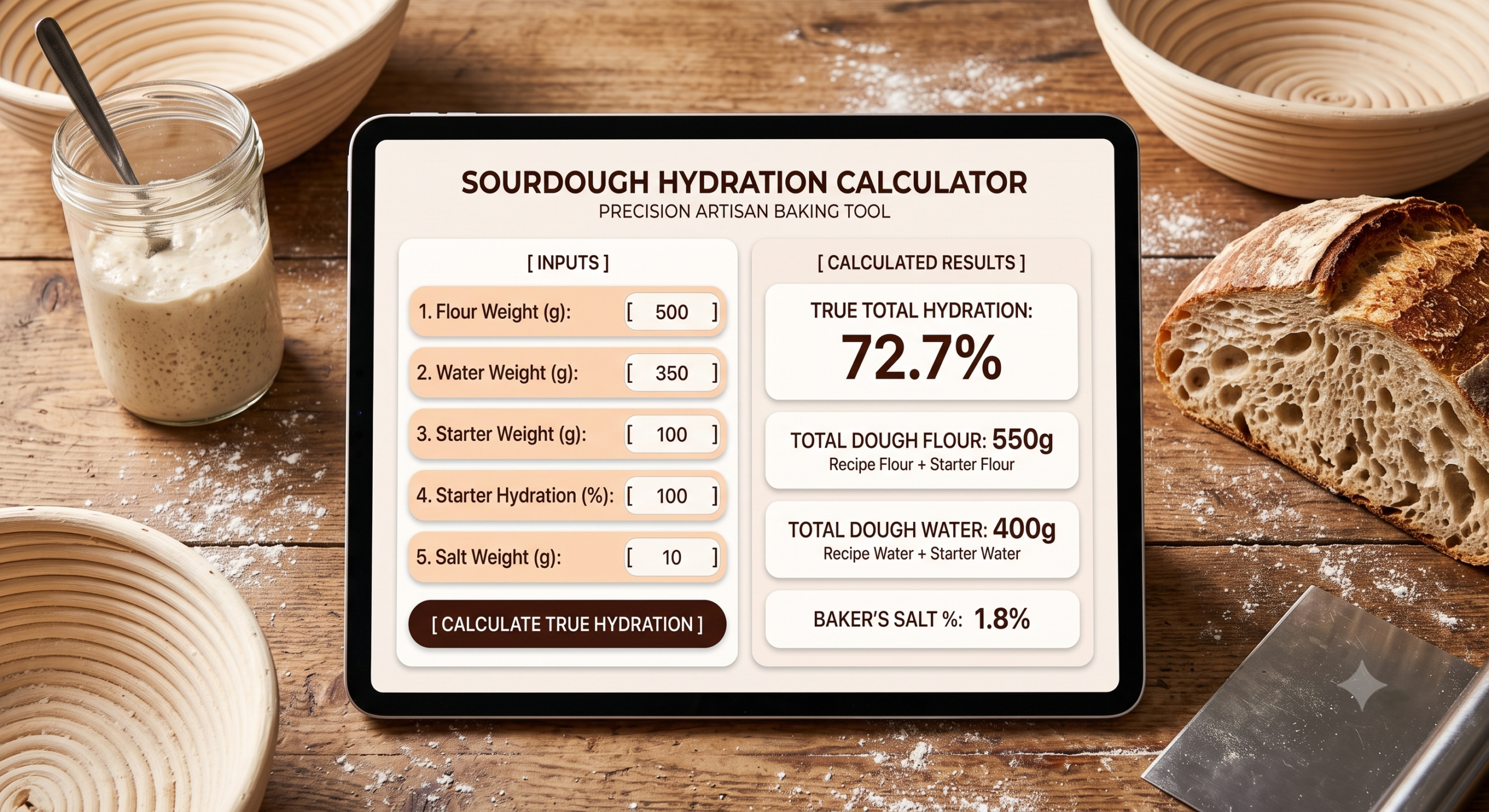
To help you visualize how a digital sourdough hydration calculator formats inputs and calculates outputs, reference this UI layout structure:
+-----------------------------------------------------------------------+
|                    SOURDOUGH HYDRATION CALCULATOR                     |
|           Precision Baker's Percentages & Total Moisture Tool         |
+-----------------------------------------------------------------------+
|  [ INPUT PARAMETERS ]                  |  [ CALCULATED OUTPUTS ]     |
|                                        |                              |
|  Main Dough Flour (g):  [ 450 ]        |  Total Batch Flour:   500 g  |
|  Main Dough Water (g):  [ 320 ]        |  Total Batch Water:   370 g  |
|                                        |                              |
|  Starter Weight (g):    [ 100 ]        |  Starter Flour:        50 g  |
|  Starter Hydration (%): [ 100 ]        |  Starter Water:        50 g  |
|                                        |                              |
|  Salt Weight (g):       [  10 ] (2.0%) |  TOTAL HYDRATION:     74.0%  |
|                                        |                              |
|  Flour Type Selection:                 |  CRUMB PREDICTION:           |
|  (X) High-Protein Bread Flour          |  [Medium-Open Artisan Crumb] |
|  ( ) Whole Wheat / Rye Blend           |                              |
+-----------------------------------------------------------------------+
|  [ ACTION: RECALCULATE ]    [ ADJUST TARGET HYDRATION TO 78% ]        |
+-----------------------------------------------------------------------+
Frequently Asked Questions (FAQs)
1. What is the best sourdough hydration percentage for beginners?
A target hydration of 68% to 72% is ideal for beginner sourdough bakers. This range provides a soft, open crumb structure while keeping the dough manageable during shaping without excessive stickiness.
2. How does starter hydration alter a sourdough hydration calculator model?
Because a sourdough starter contains both flour and water, its individual hydration percentage directly changes the dough’s total moisture balance. A sourdough hydration calculator breaks down the starter weight into its flour and water fractions to ensure your recipe’s true total hydration is accurate.
3. Can I convert a low-hydration recipe into a high-hydration recipe using a sourdough hydration calculator?
Yes. Enter your baseline flour and starter weights into a sourdough hydration calculator, set your new target hydration percentage (e.g., increasing from $68\%$ to $78\%$), and the calculator will display the exact additional grams of water required.
4. Why is my 75% hydration dough unmanageably sticky?
Excessive stickiness usually stems from using flour with insufficient protein content, skipping the autolyse phase, or under-developing the gluten network through stretch-and-folds. Humidity or over-fermentation can also degrade dough structure.
5. Does salt affect sourdough hydration calculations?
Salt does not add liquid volume, so it is not counted as hydration in a sourdough hydration calculator. However, salt plays a crucial mechanical role by tightening the gluten network and controlling yeast activity. Standard salt usage ranges from $1.8\%\text{ to }2.2\%$ of total flour weight.
6. What is the manual formula to calculate sourdough hydration?
To calculate sourdough hydration manually:
7. How do I adjust hydration when adding whole wheat to a white flour recipe?
Whole wheat flour absorbs more water than white flour due to its bran content. When substituting whole wheat into a white flour recipe, use a sourdough hydration calculator to increase total hydration by roughly $1\%$ for every $10\%$ of whole wheat added.
Conclusion: Achieve Baking Consistency with Precision
Mastering sourdough bread baking requires shifting from rough estimates to precise baker’s percentages. By utilizing an automated sourdough hydration calculator, you can control dough consistency, adapt recipes to different flour varieties, and refine your technique with confidence.
Whether you are baking a sturdy sandwich bread at $65\%$ hydration or targeting an airy, open-crumb country loaf at $78\%$ hydration, let a sourdough hydration calculator handle the underlying math so you can focus on mastering your shaping, fermentation, and bake!

