Number Sequence Calculator
All-In-One Sequence Calculator: Solve Arithmetic, Geometric, and Fibonacci Progressions
Whether you are a student tackling complex algebra, a programmer designing algorithmic logic, or a mathematician analyzing statistical datasets alongside a z-score calculator, working with numerical sequences requires precision. Finding the n-th term, calculating the total sum of a series, or mapping out sequence stream matrix elements by hand is both time-consuming and prone to human error
That is exactly why this sequence calculator was built.
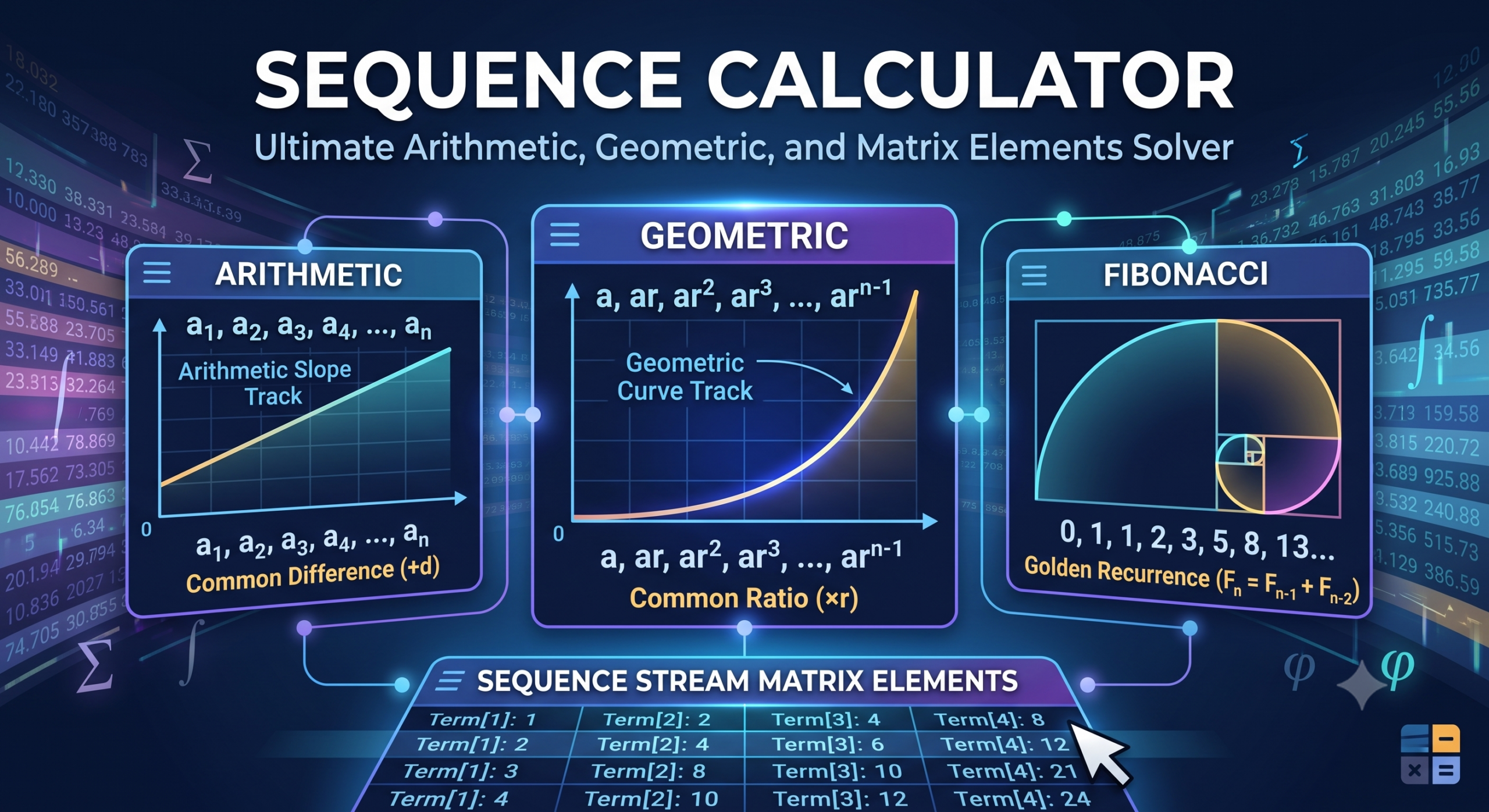
This comprehensive suite of tools is designed to be your ultimate math utility. It instantly handles arithmetic sequences, geometric progressions, and Fibonacci sequences. With a built-in instant calculation engine and dynamic visual graphs, this tool doesn’t just give you the answer—it shows you the trajectory of your data.
In this comprehensive guide, we will break down exactly how to use each tool, the mathematical formulas powering them, and the real-world applications of sequence stream matrix elements.
What is a Sequence Calculator?
A sequence calculator is an advanced mathematical tool designed to evaluate ordered lists of numbers that follow a specific pattern or rule. In mathematics, a “sequence” is simply a collection of objects (usually numbers) in which repetitions are allowed and order matters.
Our all-in-one sequence solver performs several critical functions simultaneously:
-
Finds the Target Term: Identifies the exact value of any n-th term in a progression.
-
Calculates the Sum: Computes the total sum of the sequence up to your chosen index (Sn).
-
Generates Matrix Streams: Outputs the entire sequence stream matrix elements in a clean, readable list.
-
Visualizes the Data: Graphs the mathematical trajectory (like an arithmetic slope or a geometric curve) in real-time.
By grouping an arithmetic sequence calculator, a geometric sequence calculator, and a Fibonacci sequence calculator onto one page, you have a complete utility station for any progression problem.
[ez-toc]
Tool 1: Arithmetic Sequence Calculator
An arithmetic sequence (or arithmetic progression) is a sequence of numbers where the difference between any two consecutive terms is always constant. This constant is known as the Common Difference (f).
For example, in the sequence 1, 3, 5, 7, 9, the common difference is 2.
The Mathematical Formulas
Our arithmetic progression calculator utilizes the standard algebraic formulas to fetch your results instantly.
To find the n-th term (an), the tool uses:
an = a1 + (n – 1)f
To find the sum of the arithmetic sequence (Sn), the tool uses:
Sn = (n / 2) [2a1 + (n – 1)f]
Where:
-
a1 = First Term
-
f = Common Difference
-
n = Target Term Index
How to Use the Arithmetic Sequence Calculator
Referencing our intuitive interface, solving linear progressions takes just three steps:
-
Enter the First Term (a1): Input the starting number of your sequence. For instance, if your sequence starts at 1, enter
1. -
Input the Common Difference (f): Enter the linear step by which the sequence grows or shrinks. If the sequence goes up by 2 each time, enter
2. -
Set the Target Term Index (n): Decide which specific position in the sequence you want to find. If you want to know the 10th number in the pattern, enter
10.
Understanding Your Results:
Once you input these values (and ensure Instant Calculation is toggled ON), the calculator dynamically generates the Value of the Targeted N-th Term. For the inputs 1, 2, and 10, the result is exactly 19. The tool also provides the total Sum of the Sequence (100) and plots an Arithmetic Slope Track, visualizing the linear step.
Tool 2: Geometric Sequence Calculator
A geometric sequence (or geometric progression) is a series of numbers where each term after the first is found by multiplying the previous term by a fixed, non-zero number called the Common Ratio (r).
Unlike arithmetic sequences that grow in a straight line, geometric sequences grow exponentially, making this geometric sequence calculator vital for calculating compound interest, population growth, or computer algorithms.
The Mathematical Formulas
To calculate the n-th term of a geometric series, the tool applies the following exponential equation:
an = a1 * rn-1
To calculate the sum of the first n terms of a geometric sequence (Sn), we use:
Sn = a1 [(1 – rn) / (1 – r)] (for r ≠ 1)
Where:
-
a1 = First Term
-
r = Common Ratio
-
n = Target Term Index
How to Use the Geometric Sequence Calculator
-
Enter the First Term (a1): Define the starting point of your exponential curve (e.g.,
1). -
Input the Common Ratio (r): Define the multiplier. If your sequence doubles every step, enter
2. -
Set the Target Term Index (n): Input the index number you wish to solve for (e.g.,
8).
Understanding Your Results:
With Instant Calculation active, the tool tracks the exponential ratio trajectories automatically. For inputs 1, 2, and 8, the calculator instantly reveals the target term is 128, with a total sequence sum of 255. You will also notice the Geometric Curve Track graph visually plotting the steep exponential growth caused by the ratio scalar.
Tool 3: Fibonacci Sequence Calculator
The Fibonacci sequence is one of the most famous number patterns in mathematics. In this sequence, each number is the sum of the two preceding ones, usually starting with 0 and 1.
The sequence looks like this: 0, 1, 1, 2, 3, 5, 8, 13, 21, 34…
This pattern appears frequently in nature (like the arrangement of leaves on a stem or the spiral of a shell), art, architecture, and computer data structures.
The Mathematical Formula
Our Fibonacci sequence generator relies on the strict addition recurrence rule:
Fn = Fn-1 + Fn-2
(With seed values F0 = 0 and F1 = 1)
How to Use the Fibonacci Calculator
Because the Fibonacci rules are universal, this tool requires only a single input from the user:
-
Enter the Number of Terms (n): Simply input the index of the Fibonacci number you want to find. For example, if you want the 10th element in the sequence, enter
10.
Understanding Your Results:
The calculator instantly applies the golden recurrence rules to output the value. For an input of 10, the target element is 34. To the right, the tool generates a beautiful Fibonacci Expansion Spiral, graphing the unique curve that this natural sequence creates.
Exploring the “Sequence Stream Matrix Elements” Feature
One of the most powerful features across all three tools on this page is the Sequence Stream Matrix Elements output box.
Standard calculators only give you the final answer—the single n-th term. However, when working in programming, data science, or advanced mathematics, you often need the entire array of numbers leading up to that term.
The Sequence Stream Matrix Elements log acts as an array generator. It prints out every single term in the sequence up to your target index in a clean, scrollable matrix list.
For example, in the Fibonacci calculator set to 10 terms, the matrix will display:
-
Index [1] » 0 -
Index [2] » 1 -
Index [3] » 1 -
Index [4] » 2 -
…all the way to
Index [10] » 34.
This feature allows you to easily copy the entire stream of numbers to paste into Excel, a Python script, or a homework assignment, saving you from having to manually calculate and write down the intervening numbers.
What Makes This Sequence Calculator Better? (Key Features)
When developing utilities for Brain Calculator, the goal is always to create tools that go beyond basic text outputs. This sequence solver is packed with unique features designed for a premium user experience:
-
Instant Calculation Toggle: No need to constantly click a “Submit” or “Calculate” button. Turn on the “Instant Calculation” switch, and the tool will dynamically calculate progression metrics live as you type.
-
Dynamic Visual UI: Numbers can be abstract. Our tool translates your inputs into live visual graphs. Watch the Arithmetic Slope Track map linear steps, the Geometric Curve Track visualize exponential growth, and the Fibonacci Expansion Spiral draw natural recurrence rules.
-
Comprehensive Output: In one view, you get the target term, the mathematical sum of the sequence, the common difference/ratio isolated, and the full sequence stream matrix.
-
Clean, Distraction-Free Interface: Built with intuitive input fields, helpful tooltips (the small “i” icons), and a responsive design that works perfectly on both desktop and mobile devices.
Comparative Table: Which Sequence Are You Working With?
If you have a string of numbers but aren’t sure which tool to use, refer to this quick diagnostic matrix:
| Feature | Arithmetic Sequence | Geometric Sequence | Fibonacci Sequence |
| Core Rule | Addition / Subtraction | Multiplication / Division | Sum of two previous terms |
| Key Identifier | Common Difference (f) | Common Ratio (r) | Golden Recurrence |
| Growth Pattern | Linear (Straight line) | Exponential (Curved) | Recursive Spiral |
| Example | 2, 4, 6, 8, 10 | 2, 4, 8, 16, 32 | 0, 1, 1, 2, 3, 5, 8 |
| Best Used For | Simple interest, distances | Compound interest, algorithms | Nature modeling, computing |
Real-World Applications of Number Sequences
Why do we need a sequence calculator in the first place? Number sequences are not just theoretical math problems; they are the foundational language for many real-world industries.
1. Finance and Economics
Financial analysts use sequence formulas daily. If you are calculating simple interest, you are looking at an arithmetic sequence. If you are projecting compound interest on a savings account or modeling inflation rates, you are dealing with a geometric sequence.
2. Computer Science and Programming
Developers frequently use the sequence stream matrix elements generated by these equations. Arrays, loops, and recursive functions in code heavily rely on understanding sequences. The Fibonacci sequence, in particular, is a staple in algorithm design, search techniques (like the Fibonacci search technique), and data structure optimization.
3. Architecture and Design
The Fibonacci sequence and the resulting Golden Ratio are heavily utilized in architecture, graphic design, and art to create aesthetically pleasing, naturally scaled proportions.
How to Share & Bookmark This Tool
If you found this sequence calculator helpful for your homework, lesson planning, or web development project, sharing it is easy.
-
For Students & Teachers: Bookmark this page (
Ctrl + DorCmd + D) to keep it handy during algebra and calculus study sessions. It is the perfect companion for checking your manual work. -
Share with Peers: Simply copy the URL from your browser’s address bar and paste it into your study group’s WhatsApp, Slack, or Discord channels.
Frequently Asked Questions (FAQ)
To ensure you have all the information you need, here are answers to the most common questions regarding sequences and sequence solvers.
What is the difference between an arithmetic and a geometric sequence?
The main difference lies in how you get from one term to the next. In an arithmetic sequence, you add or subtract the exact same value (common difference) each time. In a geometric sequence, you multiply or divide by the exact same value (common ratio) each time.
How do I find the n-th term of a sequence without a calculator?
You would need to manually apply the specific formula for the sequence type. For an arithmetic sequence, you apply an = a1 + (n-1)f. However, for very large values of n, doing this manually is time-consuming, which is why using an automated sequence calculator is recommended.
What does the ‘Sequence Stream Matrix Elements’ section do?
Instead of only giving you the final answer, this specific output box lists every single number in the sequence from the first term all the way to your target term. It acts as an array list that you can easily copy and paste for data tracking.
Can the sequence calculator handle negative numbers?
Yes. You can input negative numbers for your First Term, Common Difference, or Common Ratio. The tool’s algebraic engine will perfectly calculate negative descents and alternating geometric sequences (where terms flip between positive and negative).
What does the “Instant Calculation” switch do?
When turned on, it allows the tool to process your data dynamically. As soon as you type a number into the input fields, the progression metrics, sums, and visual graphs update live—no clicking required.
Why is my geometric sequence growing so fast?
Geometric sequences represent exponential growth. Because you are multiplying the previous number every single time, the values compound rapidly. This is visually represented in our tool by the “Geometric Curve Track,” which will show a sharp upward trajectory compared to the flat line of an arithmetic slope.

